Date: 10–13 August 2026
Venue: The Ritz-Carlton Hotel, Kuala Lumpur
Participating Organisations: Petrofac (Malaysia PM-304) Limited, MEDCO E&P Indonesia, Petroleum Authority of Brunei, Hibiscus Oil & Gas Malaysia Limited, EnQuest Petroleum and Vestigo Petroleum Sdn Bhd
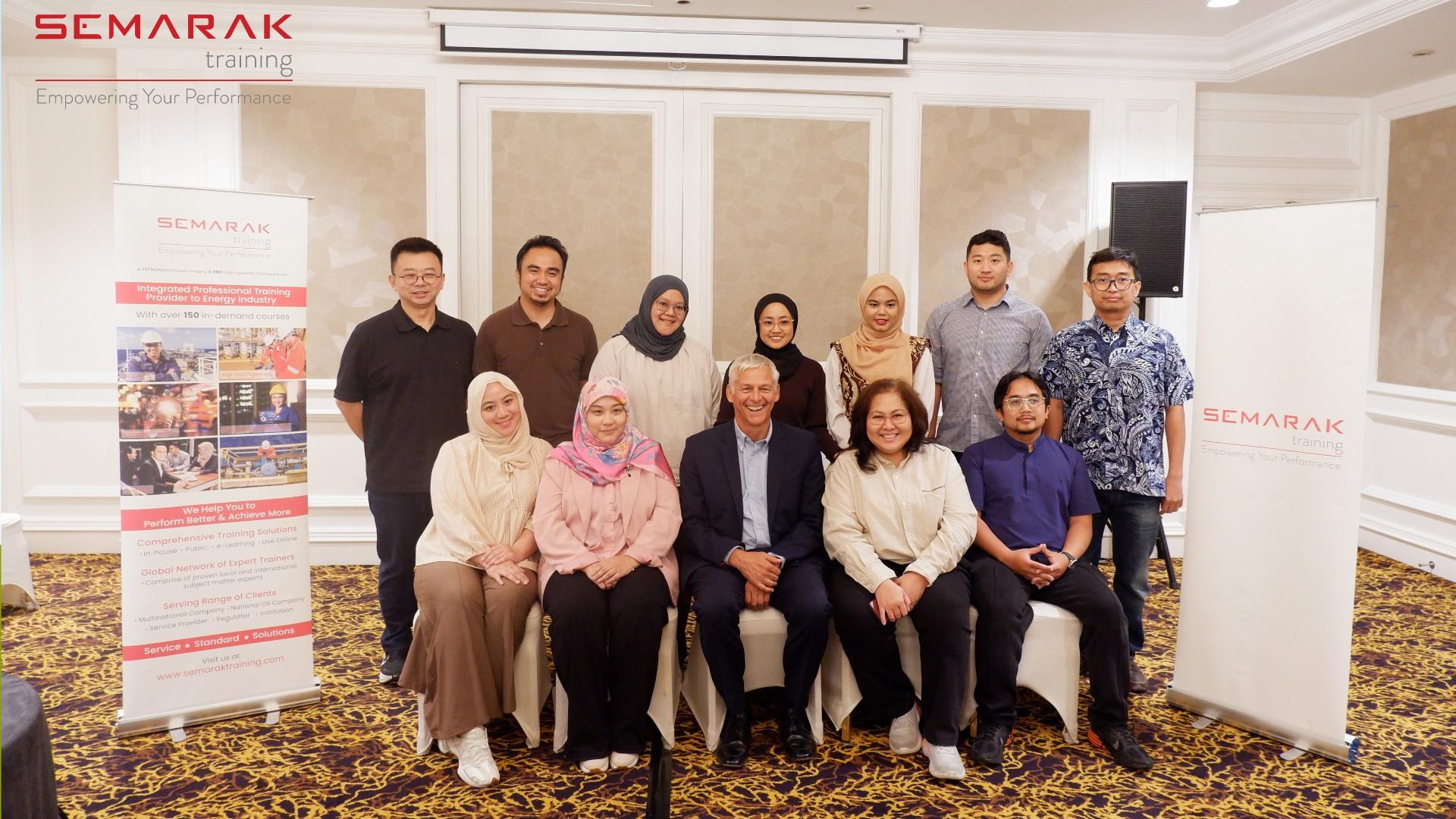
SEMARAK Training successfully conducted the Cost Estimation and Analysis of Decommissioning and Abandonment Activities training programme from 10 to 13 August 2026 at The Ritz-Carlton Hotel, Kuala Lumpur.
The four-day programme was designed to strengthen participants’ understanding of cost estimation practices for decommissioning and well abandonment activities, with particular emphasis on financial planning, project uncertainty, risk management and cost control.
Understanding Cost Estimation in Decommissioning
Decommissioning and abandonment projects can involve significant technical, operational and financial uncertainties.
Developing a reliable cost estimate is therefore an important part of project planning, helping organisations prepare appropriate financial provisions and better understand the potential costs associated with future decommissioning liabilities.
However, decommissioning costs can be difficult to predict accurately. Project complexity, incomplete information, uncertain work scopes and assumptions made during the planning stage can all influence the final cost.
Throughout the programme, participants explored how structured cost-estimation practices can support more realistic planning and provide a stronger foundation for decommissioning and abandonment decisions.
Building Reliable Cost Estimates
The programme introduced participants to the principles and methods used to develop more structured and reliable project cost estimates.
The training strengthened participants’ understanding across several areas, including:
- Types of estimates and their limitations
- Classes of Estimate and their applications
- Cost-estimation methods
- Appropriate levels of estimate accuracy
- Key drivers of abandonment and decommissioning costs
- Development of a Basis of Estimate
- Benchmarking and reconciliation
- Probabilistic estimation
- Inflation, discounting and future factors
- Cost control and lessons learnt
The course also incorporated Recommended Practices developed and maintained by the Association for the Advancement of Cost Engineering (AACE), providing participants with exposure to recognised approaches used in cost-estimation practices.
Managing Uncertainty and Project Risk
Cost estimation in decommissioning is not simply about developing a single expected project cost.
Projects may be affected by technical risks, work-scope uncertainties, operational conditions and assumptions made during the planning process.
During the programme, participants explored how these uncertainties can be identified and incorporated into the estimation process.
Topics included the development of decommissioning and abandonment philosophies, the impact of assumptions, the use of risk registers, application of contingencies and the development of probabilistic estimates.
Participants also examined the differences between probabilistic and deterministic approaches, helping them understand how uncertainty can be better represented when developing project cost estimates.
Developing the Basis of Estimate
A well-developed Basis of Estimate provides an important foundation for understanding how a project estimate has been prepared.
It documents the assumptions, scope, estimation methodology, uncertainties and other factors that influence the estimated project cost.
During the programme, participants explored the key elements involved in developing a Basis of Estimate using the AACE model.
The training also covered the application of contingencies to technical risks and work-scope uncertainties, benchmarking and reconciliation, probabilistic estimation and the transfer of estimates into financial planning.
These areas helped participants understand how a structured estimation process can improve transparency and provide greater confidence when communicating and reviewing project cost expectations.
From Cost Estimation to Cost Control
Developing an estimate is only one part of managing decommissioning and abandonment costs.
Effective project management also requires organisations to understand the factors that can lead to cost overruns and identify opportunities for better cost control throughout the project lifecycle.
The final part of the programme explored common causes of cost overruns in well abandonment and decommissioning, opportunities for cost minimisation, risk-mitigation approaches, industry lessons, project maturation, record keeping and project close-out.
By connecting cost estimation with cost control, participants gained a broader perspective on how estimates can continue to support project planning and financial management as a project progresses.
A Practical Learning Experience
The four-day programme provided participants with opportunities to explore the practical challenges involved in estimating and managing decommissioning and abandonment costs.
Through technical explanations, discussions and industry-based examples, participants were able to examine how different estimation methods, assumptions, uncertainties and risks can influence project cost expectations.
This approach helped strengthen participants’ understanding of how structured cost-estimation practices can support more informed planning and decision-making throughout the decommissioning and abandonment process.
Supporting Decommissioning Competency Development
SEMARAK Training is pleased to continue supporting industry professionals in strengthening their capabilities across decommissioning, well abandonment and project cost management.
We sincerely appreciate the participation and engagement shown by professionals from Petrofac (Malaysia PM-304) Limited, MEDCO E&P Indonesia, Petroleum Authority of Brunei, Hibiscus Oil & Gas Malaysia Limited, EnQuest Petroleum and Vestigo Petroleum Sdn Bhd throughout the four-day programme.
SEMARAK Training remains committed to delivering practical, industry-focused learning programmes that help professionals strengthen competency, manage project challenges more effectively and support better technical and commercial decision-making.
#SEMARAKTraining #EmpoweringYourPerformance