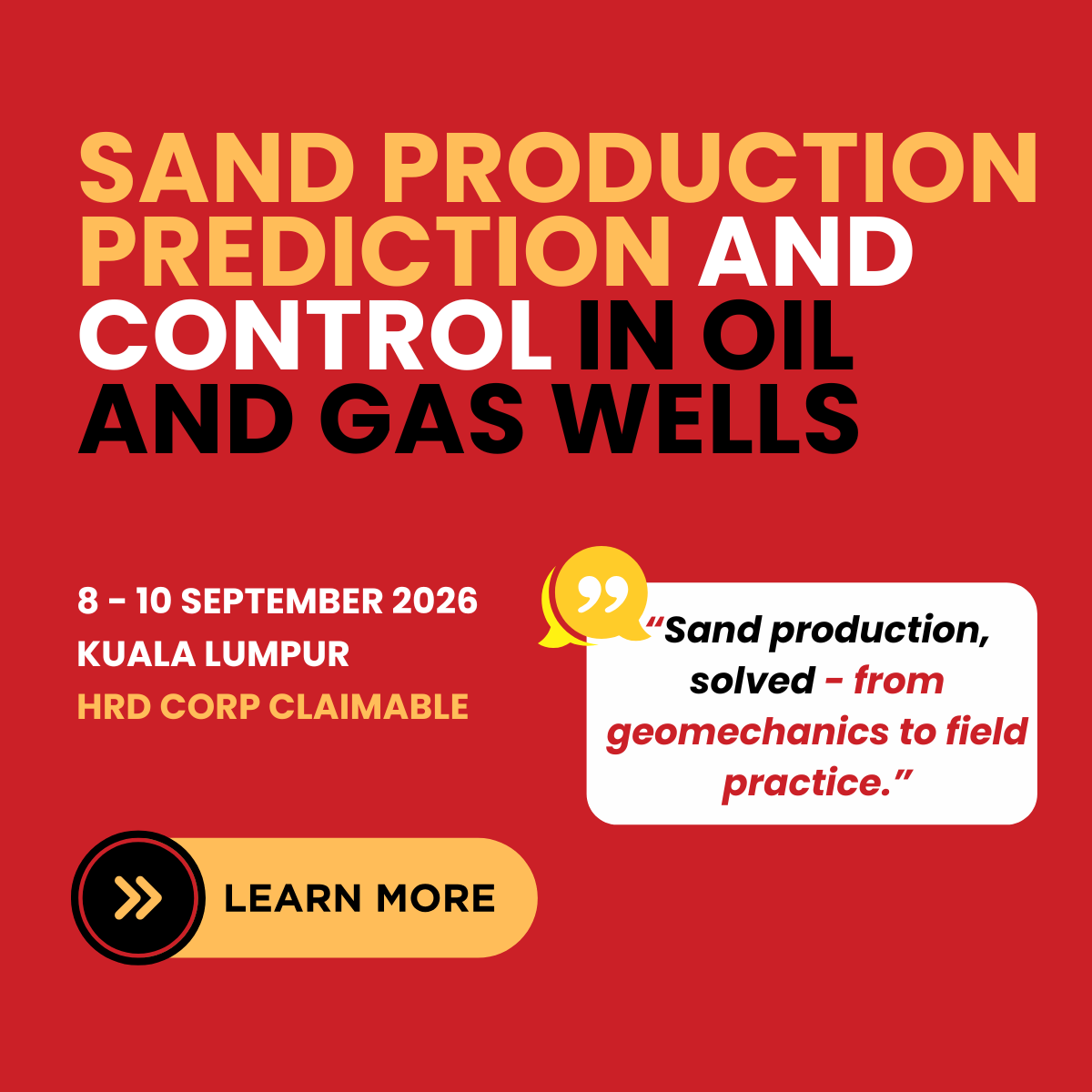



Sand production is one of the most serious challenges faced in sandstone oil and gas reservoirs.
When formation sand enters the wellbore, it can reduce production, damage completion equipment, erode surface facilities and increase operating costs. Without proper prediction and control, sanding problems may also affect well integrity and long-term asset performance.
SEMARAK Training’s Sand Production Prediction and Control in Oil and Gas Wells programme equips engineers and geoscientists with practical knowledge to predict sanding risks, select suitable control methods and manage sand-producing wells more effectively.
Manage Sand Production from Prediction to Field Application
Effective sand management begins before sand reaches the surface.
Engineers must assess formation strength, reservoir stresses, pressure depletion and drawdown conditions to determine when sanding may occur. They must then select a control strategy that balances sand exclusion, well productivity and operational reliability.
This three-day programme covers the complete sand-management workflow—from formation-failure analysis and sanding prediction to completion design, productivity evaluation and field surveillance.
Practical examples, case studies and field-based insights will help participants connect geomechanics principles with real production and completion challenges.
What You Will Gain
- Sand-production mechanisms and formation-failure concepts
- Practical methods for predicting sanding onset and production rates
- Sand-control selection criteria for different reservoir and well conditions
- Design principles for screens, gravel packs and frac packs
- Productivity evaluation for sand-controlled wells
- Sand-monitoring and surveillance practices
- Troubleshooting approaches for sand-control performance issues
- A structured workflow for developing field sand-management plans
Programme Highlights
The programme covers key areas including:
- Fundamentals and consequences of sand production
- Reservoir, well and completion factors influencing sanding
- Formation strength and stress characterisation
- Wellbore stability and near-wellbore failure
- Sanding-onset and sand-rate prediction
- Effects of drawdown, depletion, flow rate and water production
- Standalone screens, gravel packs and frac packs
- Particle-size distribution and sieve analysis
- Sand-control completion design and selection
- Risks and failure modes of sand-control systems
- Productivity impairment, skin and completion pressure losses
- Operating-envelope and drawdown management
- Sand monitoring, troubleshooting and remedial options
- Field case studies and sand-management planning
Participants will examine how sand-control decisions can affect both short-term production and long-term well performance.
Who Should Attend
- Drilling engineers
- Completion engineers
- Production engineers
- Reservoir engineers
- Facilities engineers
- Geoscientists
- Professionals involved in sand control, well performance or field development
Programme Details
Date: 8–10 September 2026
Duration: 3 days
Venue: Kuala Lumpur
This programme is HRD Corp claimable.
Protect Well Performance and Reduce Sand-Related Risks
Effective sand management requires the right balance between production performance, completion reliability and operational risk.
Equip your technical team with the knowledge required to predict sanding behaviour, evaluate sand-control options and develop more effective strategies for sand-producing wells.
Download the course brochure for the full programme, fees and registration details: